Swift®lock 2077
1 of 29 products in this brandSwift®lock 2077 is a single component polyurethane hot-melt product. It works perfect at bonding various plastic of automobile industry, such as different ABS, PC, leather, metal, and other substrates.
Chemical Family: Polyurethanes (PU)
Application Method: Nozzle, Roller
Compatible Substrates & Surfaces: Acrylonitrile Butadiene Styrene (ABS), Leather, Metal, Plastics, Polycarbonate (PC)
Features: Excellent Humidity Resistance, Fast Setting, Good Green Strength, Good Mechanical Properties, High Bond Strength, Short Open Time, Very Good Heat Resistance
-
Type Document Name
-
Technical Data SheetSwift®lock 2077 Technical Data Sheet
Enhanced TDS
Identification
- Chemical Family
- GBU
- RTU Product Type
- Categories
-
Application Information
- Cure Method
Applications
- Application Area
- Application Method
- Compatible Substrates & Surfaces
Applications & Uses
- Application Instructions
-
- Do not open the package before complete the thawing
- Thawing to temperature (160°C) before using.
- Seal any remaining material and store immediately at temperature not up to 40°C.
- We do not recommend thawing material more than three times
Features
- Ready-to-Use Product Features
Features & Benefits
- Product Highlights
-
- One component requires no mixing
- High bond strength on variety of substrates
- Short open time and good green strength
- Excellent heat/humidity resistance
Packaging & Availability
- Regional Availability
Physical Properties
- Physical Form
- Appearance
-
White solid
Properties
- Specifications
-
Value Units Test Method / Conditions Activated Temperature min. 60 °C Internal Method, PVC-ABS tensile test - Processing Parameters
-
Value Units Test Method / Conditions Curing Time (Final bonding strength, depending on moisture content and ambient temp) 5 - 7 d - Minimum Substrate Temperature 20 °C - Open Time 10 - 20 sec Internal HBF Standard Processing Temperature 120 - 140 °C - Softening Point 71 °C Ring and Ball method, DIN EN 1427 Storage Temperature -25 to 35 °C - Viscosity (at 140 °C, Spindle 27, 10 min⁻¹) 23000 mPa.s Brookfield Thermosel - Physical Properties
-
Value Units Test Method / Conditions Density 1.1 g/cm³ - - Appearance
-
Milky white solid
Storage & Handling
- Storage Information
-
- Swift®lock 2077 should be used within the shelf life specified on the packaging.
- The storage stability applies to material stored under appropriate conditions only (original unopened containers, recommended storage temperature).
- Shelf Life
-
9 months, 9 months -
Technical Details & Test Data
- Curing Profile
-
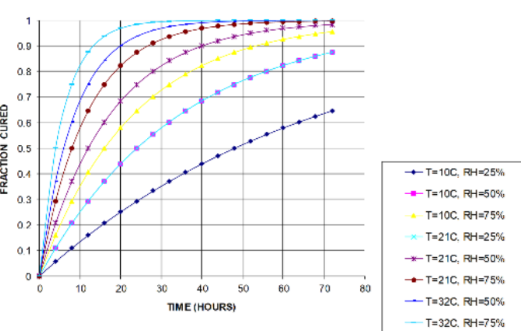
- The formation of the swift ®lock2077 adhesive polymer is based on a moisture- curing mechanism; it depends on the temperature, humidity, applied glue thickness and permeability of substrates.
The ideal curing conditions should follow conditions:
- Temperature:15~40°C
- Relative humidity: 50~75%
- Film thickness: <0.5mm