
Cyberbond CB AT 6085
1 of 68 products in this brandRTU Product Type: 2K (2 component) Adhesive, Anaerobic Adhesive, Anaerobic Sealant, Reactive Adhesive
Compatible Substrates & Surfaces: Acrylonitrile Butadiene Styrene (ABS), Composites, Metal, Plastics, Polyamide, Polycarbonate (PC), Poly(Methyl Methacrylate) (PMMA), Polyvinyl Chloride (PVC)
Chemical Family: Acrylics, Acrylates & Methacrylates
Features: Good Adhesion, Weak Acid Resistant, Weak Base Resistant
-
Type Document Name
-
Technical Data SheetCyberbond CB AT 6085 Technical Data Sheet
Enhanced TDS
Identification
- Chemical Family
- GBU
- RTU Product Type
- Categories
-
Applications
- Compatible Substrates & Surfaces
Applications & Uses
- Clean Surface
-
Surfaces should be clean, dry and free of grease before bonding.
Features
- Ready-to-Use Product Features
Features & Benefits
- General Information about MMA Adhesives
-
2-component methacrylate adhesives belong to the group of reactive adhesives. The reaction starts by mixing hardener and resin. Cyberbond offers these adhesives in double cartridges in 1:1 or 10:1 ratio with static mixing tubes. This allows an easy and quick application. Methacrylate adhesives are available in different viscosities from liquid to paste-like and with different curing times. They are characterized by excellent adhesion to metals, many plastics and composite materials. The mechanical properties range from flexible to rigid.
Packaging & Availability
- Packaging Type
- Regional Availability
Properties
- Application Temperature:
-
-50~120 °C
- Flash Point:
-
10 °C
- Shelf Life:
-
12 months
- Tensile Modulus:
-
800~1200 MPa
- Tensile Strength:
-
14~18 MPa
- Viscosity:
-
2.000~6.000 cps
- Physical Properties
-
Value Units Test Method / Conditions Cure Time (full, polymer) 24 hours - E-Modulus (polymer) 800 - 1200 MPa - Elongation at Break (polymer) 15 - 30 % - Fixture Time (liquid state) 5 - 10 minutes - Flash Point (liquid state) 10 °C - Mix Ratio (liquid state) 10:1 - - Open Time (liquid state) 9 - 11 minutes - Temperature Range (polymer) -50 to 120 °C - Tensile Strength (polymer) 14 - 18 MPa - Viscosity (at 20°C, 0.5 s⁻¹) 25000 - 60000 mPa.s Cone-Plate Viscometer Viscosity (at 20°C, 160 s⁻¹) 2000 - 6000 mPa.s Cone-Plate Viscometer - Component A
-
Value Units Test Method / Conditions Density (liquid state) 1.07 g/cm³ - - Component B
-
Value Units Test Method / Conditions Density (liquid state) 1.14 g/cm³ -
Safety & Health
- Safety Information
-
- Keep the workplace clean and use in well ventilated areas only. Installll suitable exhaust system at the workplace.
- Wear suitable safety glasses and gloves.
- Keep away from heat, hot surfaces, sparks, open flames and other ignition sources.
Storage & Handling
- Storage Conditions
-
Store products in a cold and dark place at temperatures between 10°C to 20°C.
- Shelf Life
-
12 months
Technical Details & Test Data
- Technical Information
-
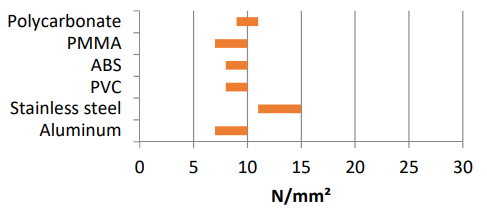
Adhesive Performance Tensile Shear Strength Substrate N/mm² Tensile shear strength (Polycarbonate,Fail) 9 - 11 Tensile shear strength (PMMA, Fail) 7 - 10 Tensile shear strength (ABS, Fail) 8 - 10 Tensile shear strength (PVC, Fail) 8 - 10 Tensile shear strength (Stainless steel) 11 - 15 Tensile shear strength (Aluminum) 7 - 10 Tensile Shear Strength
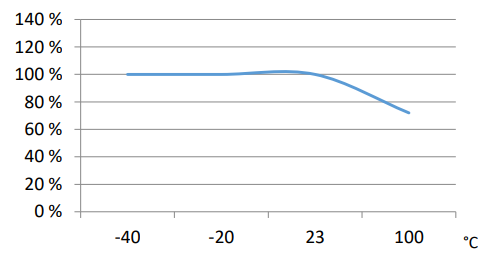
Hot strength Tested at Temperature
Resistance Against Solvents
Solvent Resistance Weak acids very good Weak bases very good Polar solvents limited Strong acids and bases limited Measurement of Viscosity
Viscosity describes the flow-ability of a liquid. Cyberbond measures the viscosity of the products by means of the cone/plate method: the liquid is applied on a panel and a defined cone presses the liquid together and rotates. Newtonian fluids are measured at shear rate 160 s-1, thixotropic products are measured at shear rate 0,5 s-1 and 160 s-1. The viscosity is measured in mPa*s at 20 °C.