
Cyberbond CB TM 47
1 of 68 products in this brandRTU Product Type: 1K (1 component) Adhesive, Anaerobic Adhesive, Thread Locker
Application Area: Fasteners
Compatible Substrates & Surfaces: Brass, Galvanized Steel, Metal, Stainless Steel, Steel
Chemical Family: Dimethacrylates
Features: Alcohol Resistant, Medium Strength, Medium Viscosity, Thixotropic
-
Type Document Name
-
Technical Data SheetCyberbond CB TM 47 Technical Data Sheet
Enhanced TDS
Identification
- Chemical Family
- GBU
- RTU Product Type
- Categories
Applications
- Application Area
- Compatible Substrates & Surfaces
Applications & Uses
- Clean Surface
-
The surface condition of the mating parts has an enormous influence on the success of a bond. To achieve good bonding success the mating parts should be clean. A certain amount of e.g. oil can be tolerated.
Features
- Ready-to-Use Product Features
Features & Benefits
- Labeling Claims
- General Information about Anaerobic Adhesives
-
Anaerobic adhesives and sealants cure by means of metal contact and/or due to the absence of air. Due to these facts they are only suitable for bonding and sealing metals. Therefore, as such they are not traditional adhesives as commonly known, but are specifically good for the bonding of metal cylindrical parts where torsion-load and shearing-load play an important part. Furthermore, anaerobics are excellent sealants for threads and flanges. Anaerobis are solvent free, one component adhesives. There are active metals (construction steel, tool steel, free cutting steel, brass, copper) and inactive metals (high alloyed or stainless steel, aluminum, electroplated surfaces, cast iron). While products used on active metals cure very fast, the same products need longer times to cure when used on inactive metals. But this does not influence the intended strength.
Packaging & Availability
- Regional Availability
Properties
- Application Temperature:
-
-50~150 °C
- Density:
-
1070 kg/m³
- Gap Fill:
-
0.0019685~0.0098425 inches
- Shelf Life:
-
12 months
- Specific Gravity:
-
1.07
- Viscosity:
-
15.000~30.000 cps
- Physical Properties
-
Value Units Test Method / Conditions Cure Time (full, polymer) 24 hours - Density (at 20°C, monomer) 1.07 g/cm³ - Gap Filling Capacity (monomer) 0.05 - 0.25 mm - Set Time (at 23°C, M10 brass bolt/nut) 20 - 45 seconds - Shear Strength (steel pin/collar specimen, after 24h) 10 - 18 N/mm² - Temperature Range (polymer) -50 to 150 °C - Viscosity (at 20°C, 0.5 s⁻¹) 15000 - 30000 mPa.s Cone-Plate Viscometer Viscosity (at 20°C, 160 s⁻¹) 400 - 1200 mPa.s Cone-Plate Viscometer - Typical Properties
-
Value Units Test Method / Conditions Storage Temperature 8 - 21 °C -
Regulatory & Compliance
- Certifications & Compliance
Safety & Health
- Safety Information
-
- Keep the workplace clean and use in well ventilated areas only. Installll suitable exhaust system at the workplace.
- Wear suitable safety glasses and gloves.
Storage & Handling
- Storage Conditions
-
Store products in a cold and dark place. Optimal storage temperature range is between 8 °C - 21 °C.
- Shelf Life
-
12 months (at 20°C in unopened bottles, monomer)
Technical Details & Test Data
- Technical Information
-
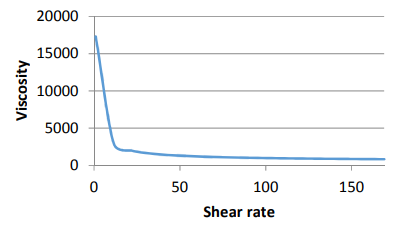
Viscosity vs Shear Rate
Adhesive Strength Substrate Nm Steel 10 to 18 Stainless steel V2A 10 to 18 Galvanized steel 12 to 20 Brass 12 to 18 Breakloose Torque
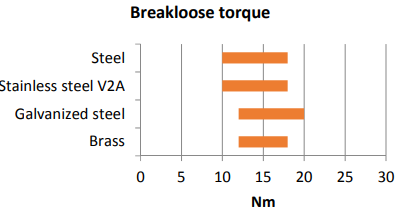
Breakloose torque on M10 bolts and nuts in Nm according to DIN 54454, free swimming without ontorque.
Solvent Resistance
Solvent Example Resistance alcohols ethanol, methanol, isopropyl alcohol + esters ethylacetate, benzoic benzyl ester, + other liquids water, freon, diesel oil + other liquids ammonium hydroxide, bromine, hydrobromic acid, lithium hydroxid, perchloric acid, potassium hydroxide - gasses acetylene, argon, butane, ethane,nitrogen + gasses ammonia, freon gas, oxygen (pure and /or oxygen rich systems), chlorine - Measurement of Viscosity
Viscosity describes the flow-ability of a liquid. Cyberbond measures the viscosity of the products by means of the cone/plate method: the liquid is applied on a panel and a defined cone presses the liquid together and rotates. You differentiate between a Newtonian and a thixotropic liquid. In terms of a Newtonian liquid you will get a relative constant viscosity graph in dependence of the rotary speed of the cone. In terms of thixotropic liquids the product becomes more liquid (down to its base viscosity) the faster the cone rotates. The viscosity is measured in mPa*s